Posts

Image
Post No. 38. Albert Einstein and the Civil Rights in America In 1946, Albert Einstein, the Nobel Prize-winning physicist traveled to Lincoln University in Pennsylvania the first school in America to grand college degrees to black Americans. He received an honorary degree and gave a lecture on relativity to the Lincoln students. This visit was ignored by the mainstream press. According to the authors Fred Jerome and Rodger Taylor, authors of “Einstein on Race and Racism” these omissions need to be recognized and corrected. Einstein was Jewish and was victim of racism, threats and harassment while working at the University of Berlin during the Nazi Germany. He found similarities between American segregation and the treatment of Jews in Germany. In January 1946, Einstein offered public encouragement to the National Association for the Advancement of Colored People (NAACP) and its founder. W.E.B.   Du Bois. In 1951, when the federal government indicted the 83-year-old ...

Image
Post No. 37: Nuremberg trials. The Nuremberg trials were a series of military tribunals held by the Allied forces under international law and the laws after World War II. The trials were most notable for the prosecution of prominent members of the political, military, judicial and economic leadership of Nazi Germany, who planned, carried out, or otherwise participated in the Holocaust and other war crimes. The trials were held in the city of Nuremberg, Germany, and their decisions marked a turning point between classical and contemporary international law. They were held between 20 November 1945 and 1 October 1946. They used some terms as “crimes against humanity”. This term “crimes against humanity” was first used by George Washington Williams in a pamphlet published in 1890 to describe the practices of Leopold II of Belgium’s administration of the Congo Free State. The Article 6 of the London Charter of the International Military Tribunal was the decree that set down t...
Image
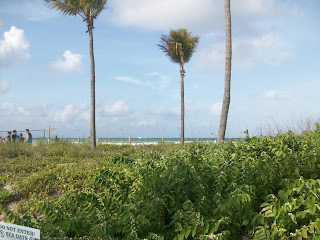
Post No. 36 Seat Oats. A tall grass (Uniola paniculate) that has panicles resembling those of the oat, grows chiefly on the coast of the southern U.S. and is useful as a sand binder (Merriam Webster Dictionary). Sea oats is a long lived, slow growing, warm season, perennial grass commonly associated with the upper dunes along beach fronts. It grows erect to approximately 6 feet in height at maturity and has leaves that can grow to 24 inches in length. The leaves are narrow, less than 1 inch in width, and taper towards their ends. Seat oats is very drought tolerant. This species produces a massive root system and will tolerate salt spray and brief inundation with salt water. It prefers full sun, and thrives in areas with blowing sand, such as dunes along the upper beach front. Sea oats is an extremely valuable plant for coast line and barrier island protect. Its massive root system is capable of holding soil and sand in place during extreme weather events such as hurricanes a...
Image
Post No. 35. Red Mangroves Rhizophora mangle, known as ‘the red mangrove’ are distributed in estuarine (partially enclosed coastal body of brackish water [water that has more salinity than fresh water, but not as much as seawater] with one or more rivers or streams flowing into it, and with a free connection to the open sea) ecosystems throughout the tropic. Rhizopora mangle grows on aerial prop roots, which arc above the water level, giving stands of this tree the characteristic “mangrove” appearance. It is a valuable plant in Florida, Louisiana, and Texas coastal ecosystems. The red mangrove is considered an invasive species (plant, fungus, or animal species that is not native to a specific location [ an introduced species] and that has a tendency to spread to a degree believed to cause damage to the environment, human economy or human health.) in some locations, where it forms dense, monospecific ( agricultural practice of producing or growing a single crop, plant , or livestoc...
Image
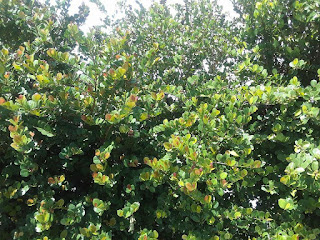
Post No. 34. Icaco. Icaco or Chrysboalanus Icaco, the cocoplum, paradise plum, abajeru or icaco, is found near sea beaches and inland throughout tropical Africa, Caribbean and in southern Florida. Coco-plums are three quarter patriotic: They can be red, white, or blue (and yellow). The “blue” is deep purple and the yellow more a cream. Trees near the shore tend to have light colored fruit that is round whereas a variation inland tends to be oval and red to dark purple. The oil in the kernel can be substituted for almond oil. The seed is about 21% oil by weight. The oil can also be used to make candles, soap, and axle grease. The coco plum fruit possess a slightly sweet flavor and can be eaten raw out of hand or also be used in preserves. The seed of the plant is also edible as it has high oil content and a nutty flavor, but somewhat bland it is also reported to be a good honey plant. Medicinally, it is used internally against dysentery, dyspepsia, and diarrhea an...
Image
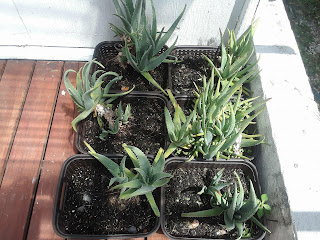
Post No. 33. Aloe Vera. Aloe Vera is a plant that has been used for medicinal purposes for some 6,000 years. Ancient Egyptians depicted the plant on stone carvings. It was given to pharaohs as a burial gift and called the plant of immortality. The leaves of the aloe Vera plant, also known as the lily oft the desert, are filled with a clear gel that is used topically. The outer green part of the leaves are used to make Aloe Vera juice for internal use. There is no medical evidence that aloe Vera helps tighten skin but there’s no harm trying it. Aloe Vera is a succulent plant species (plants that have some parts that are more than normally thickened and fleshy, usually to retain water in arid climates or soil conditions. The word “succulent” comes from the Latin word sucus, meaning juice, or sap. Succulent plants may store water in various structures, such as leaves and stems.) of the genus Aloe. An evergreen perennial, it originates from the Arabian Peninsula but grows wild i...
Image
Post No. 32. Ferns Ferns are a very ancient family of plants and belongs to a group of vascular plants and unlike other vascular plants they reproduce from spores in a stage called a gametophyte and have neither seeds nor flowers. They are older than land animals and far older than the dinosaurs. They were living on Earth for two hundred million years before the flowering plants evolved. Ferns first appear in the fossil record about 360 million yeas ago in the late Devonian period, but many of the current families and species did not appear until roughly 145 million years ago in the early Cretaceous, after flowering plants came to dominate many environments.   Some ferns are used as food, medicine, biofertilizer and ornamental plants and for remediating contaminated soil. They have been the subject of research for their ability to remove some chemical pollutants from the atmosphere. They play certain roles in mythology and art. (Photo was taken from my visit to Fern Natu...